
[This article also appears in ‘Homecoming’ journal, Edition 3]
The Northern Pennines hold a richness of ancient archaeology that abounds with stories, wonders, and mysteries. Not always beneficent, this region has also been a dumping ground for industrial human secrets and land exploitations, ones that people have hoped time and grasses would finally cover over, making them disappear into the shadows of forgotten history.
My journeys onto the moors usually reveals some hidden, and at times painful, truths etched across this semi-barren land, perhaps the remains of lead mines, where barely anything living has colonised the wound. Still raw, after many generations of hiding, exposed on the hillside, they lie, forgotten by humans but embraced by the land.
Today, I walk the dogs up on a road that is new to me. The February wind is sharp, bitter, ready to rain on me. Suddenly I come across a sign, bright red, standing sentinel and alone on the high moor. It reads:
This site contains unexploded ordnance and toxic material. Do not pick up or disturb anything you find as it may explode and cause injury or death
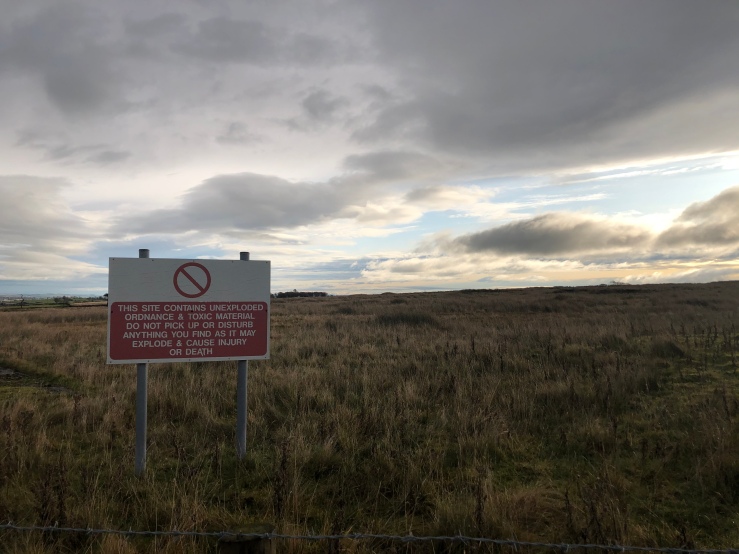
Shocked into immobility, I become viscerally aware of the lumps and scar tissue in the ground; sheets of concrete, moss-eaten at the edges as it attempted to colonise the surface, ghostly outlines of brick buildings, asphalt roads to nowhere. Up on the horizon is a skeleton of some once-huge structure, now left to collapse and return its abandoned being to the Earth.
What was this place? What on Earth could have happened here? Why was it toxic, dangerous, explosive? Was I safe? Were my dogs safe, as they tried to take bites out of a carcass of a road-killed rabbit? Amongst the enormous site were farms, and sheep. People remained in this place, to farm, to thrive. My mind went to how they must feel. Was this a landscape they loved? Or was it a landscape that kept others out, a deliberate act of hiding from the outside world? Speculation fizzed through my mind.
I looked at the OS map. The entire moor side was marked “storage site (disused)”. Truly captivated, I took out my phone and Googled it. What came up stopped me in my tracks:
“Experts put residents’ mind at rest over moor’s dangers
RESIDENTS living near a former RAF base contaminated with chemical weapons have been reassured that the site is safe.
[…….] in County Durham, was used by the RAF during the Second World War as a chemical weapons storage and disposal depot.
After the war the site was cleaned up but an investigation completed in February 2008 showed there were still traces of harmful chemicals such as sulphur mustard, lead and arsenic.
Mustard gas causes skin to blister and is also carcinogenic.
As a result of the study the Ministry of Defence launched a second, more thorough investigation into the 85- hectare site, which is used for sheep grazing.” *
I look up from the screen and take in the land around me. Here, on this lonely hill, hidden from the main road by the natural contours of the land, tons of toxic weapons were held, to be shipped eastwards to British and Allied troops to use against other humans. Dangerous work here, for the body and mind. Who worked here? Does anyone still remember this site when it was active? Would anyone tell me? Suddenly I remember my old neighbour Jack, who died last year aged 92. He had been in the Home Guard. Why didn’t he tell me of this place? Now I realise he probably knew all along, the site was on his patch, after all. He would have been tasked with protecting it, serving it somehow, no doubt. Keep it secret, keep it safe.
For all the shock and surprise which could have let my mind go wild with speculation, the site reaches into me and tells me: stop the frantic wondering. The shriek of a curlew cut through the racing thoughts, into my mind; look! Be here, not then, but here now!
Breathing in and allowing for my eyes to focus again outside of myself, the landscape pops back into focus, as if I hadn’t really be aware of my surroundings. Sparce grassess sway in the brisk, cold breeze, a kestrel rises high and hovers, gazing down, sheep graze lazily all around. A tinkle and a gush tell of deep-cut water courses. Fallen dry stone walls reach high as far as the land and the eye can go. Alive, yet wounded, this land is. I begin to see how wounds are held, like burning embers of pain, deep inside a soul for all their lives, hidden, shadowy, and if not carefully, lovingly healed, they become the next generations’ embers too. What the Earth holds, is mirrored within us, and vice versa. What humans have done is still there to be seen, write large on the landscape. It becomes the living land.
The strong sound of water becomes more insistent. It has rained a lot recently. It has rained a lot since the end of the War. The moor gushes out water that runs past the warning signs and down, into the rivers, into the river Tees and into the oceans. The water cleanses but contaminates at the same time, if that is what it has been given to carry. What are you carrying? Sorrow. I shudder with grief, shame, horror at what we have done.
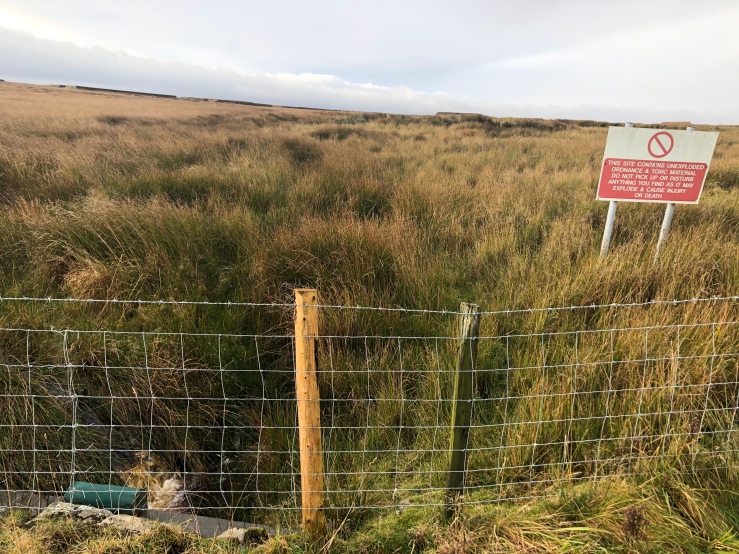
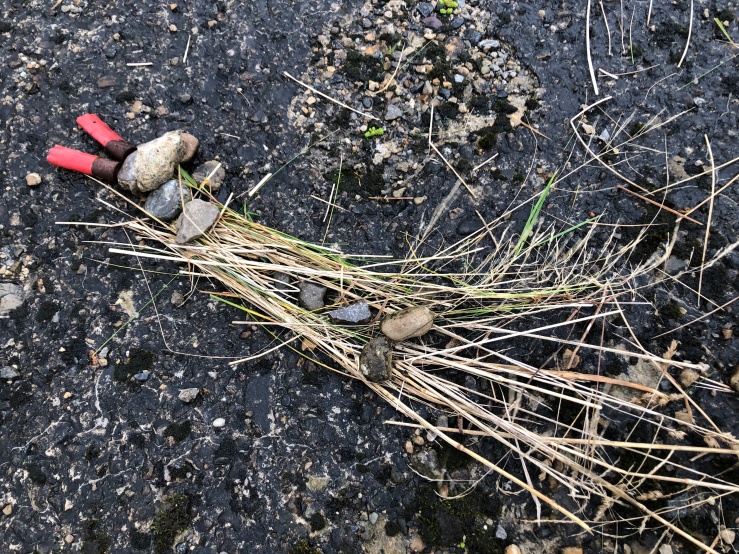
The rain that has been holding begins to fall, sharp onto my face. I have seen enough and decide to turn back. But before I do, I suddenly realise that this place cannot be an orphan from me any more. I know of it now and I want to show it that I see it, I see the underbelly of oppressive wounds and I want to bring these wounds into the light. I go to one of the trackways that must have once led somewhere, a path through looming workshops and warehouses, but now leads only onto cratered moorland. I stop and look around for things with which to make a gift. There is so very little up here, except dead rabbits, gravel and the occasional Pepsi can. I spy two spent shotgun cartridges. How fitting, I think, to make something beautiful with these for such a site. I gather some pebbles and make a tiny cairn, and pull dead reeds from the trackside. I make a bird.
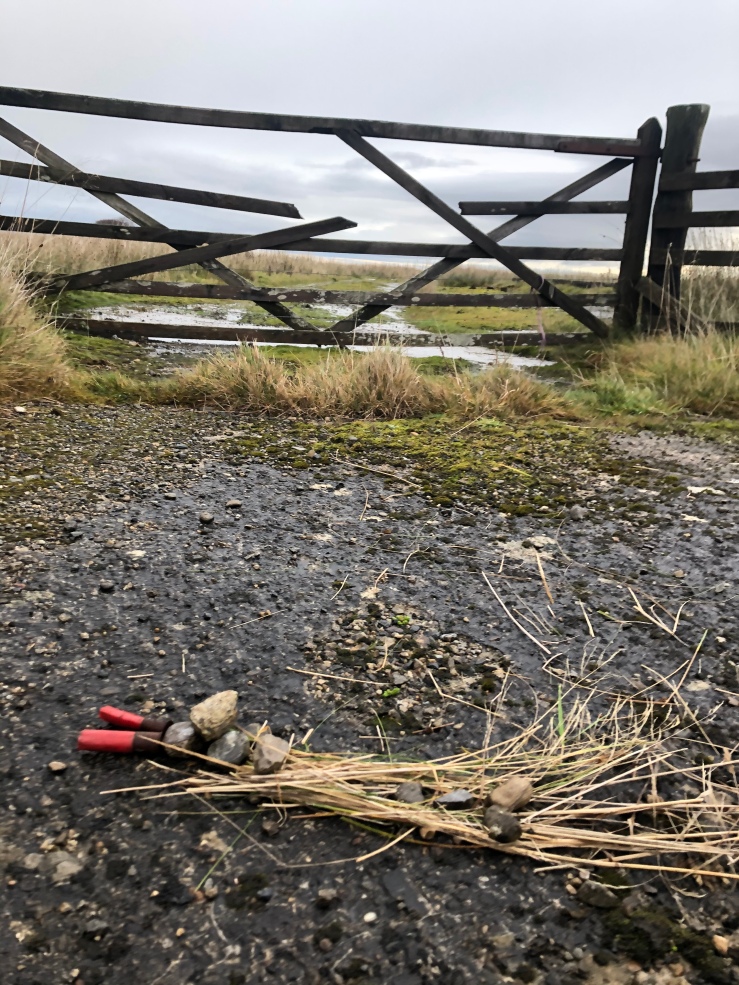
Disattisfied with what I have made, I fuss, trying to make it more beautiful with what I have. Then I stop, realising that this place has so very little to offer up, but what it has is enough and fitting.
As I walk back to the car, I slow my pace to truly take in what remains above the ground; I cannot help but let strange shapes spin my imagination back in time to the hustle and bustle of the War effort; people in RAF uniform, trucks, shouting, laughter, perhaps. I walk back the final mile, deep in my inner eye, reconstructing this whole world in my mind. What a place to have been and a time to have existed up here. Then I look up and realise that I am surrounded by an emptiness of true orphaning. This wound runs deep, I realise. But for that, the kestrel is still high above, gazing down.
The bird on the ground, in flight, a gift of beauty to this place, flutters in the cold breeze. The dry grasses soften the edges of the bird’s body as they sway, and Kestrel overhead shares the wind with this one, encouraging it to fly away with them.
I wonder if a baffled farmer will come across it lying on the crumbling asphalt and wonder at the strangeness of humans.
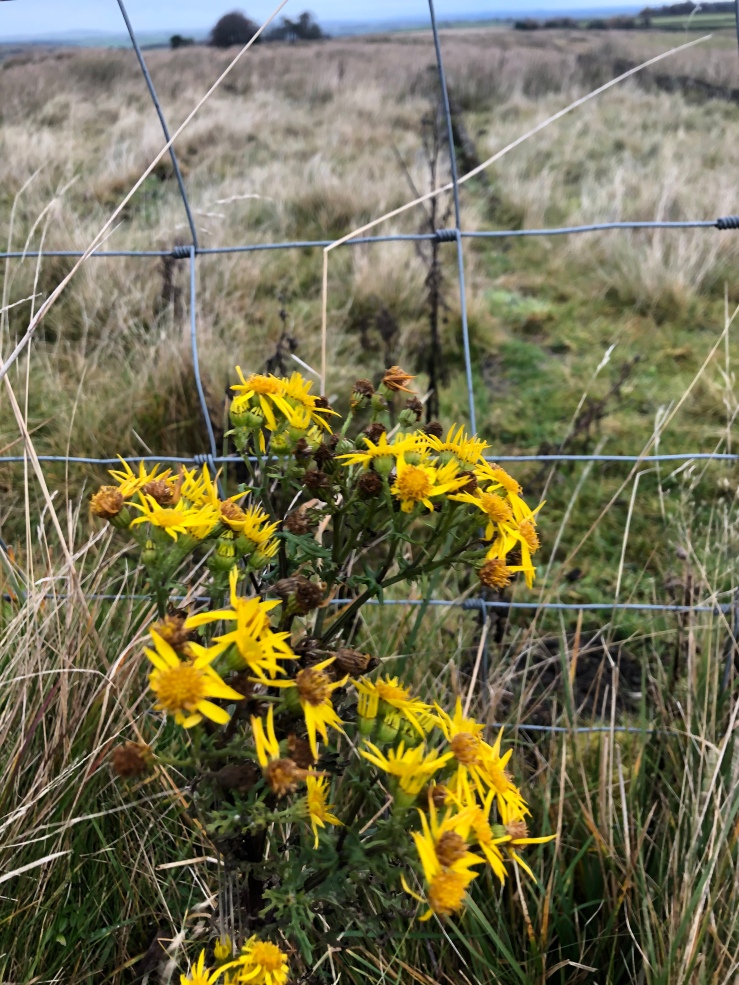
Just as I leave the site, I spy the bright yellow of ragwort by the outline of a building. Such a dangerous plant. The sheep know instinctively to leave it where it grows, but when it is cut it becomes sweet, and deadly. It nods in the brisk wind and I turn from it, filled with its message: wounded land need to belong too, even burdened with toxicity. No place is an orphan form the circle of life.
*Northern Echo 2009. https://www.thenorthernecho.co.uk/news/4193109.experts-put-residents-minds-rest-moors-dangers/
 Nwyfre